Self-growth
 Business & Career
 Success
 Communication
 Healing
 Relationships
 Psychology
 Happiness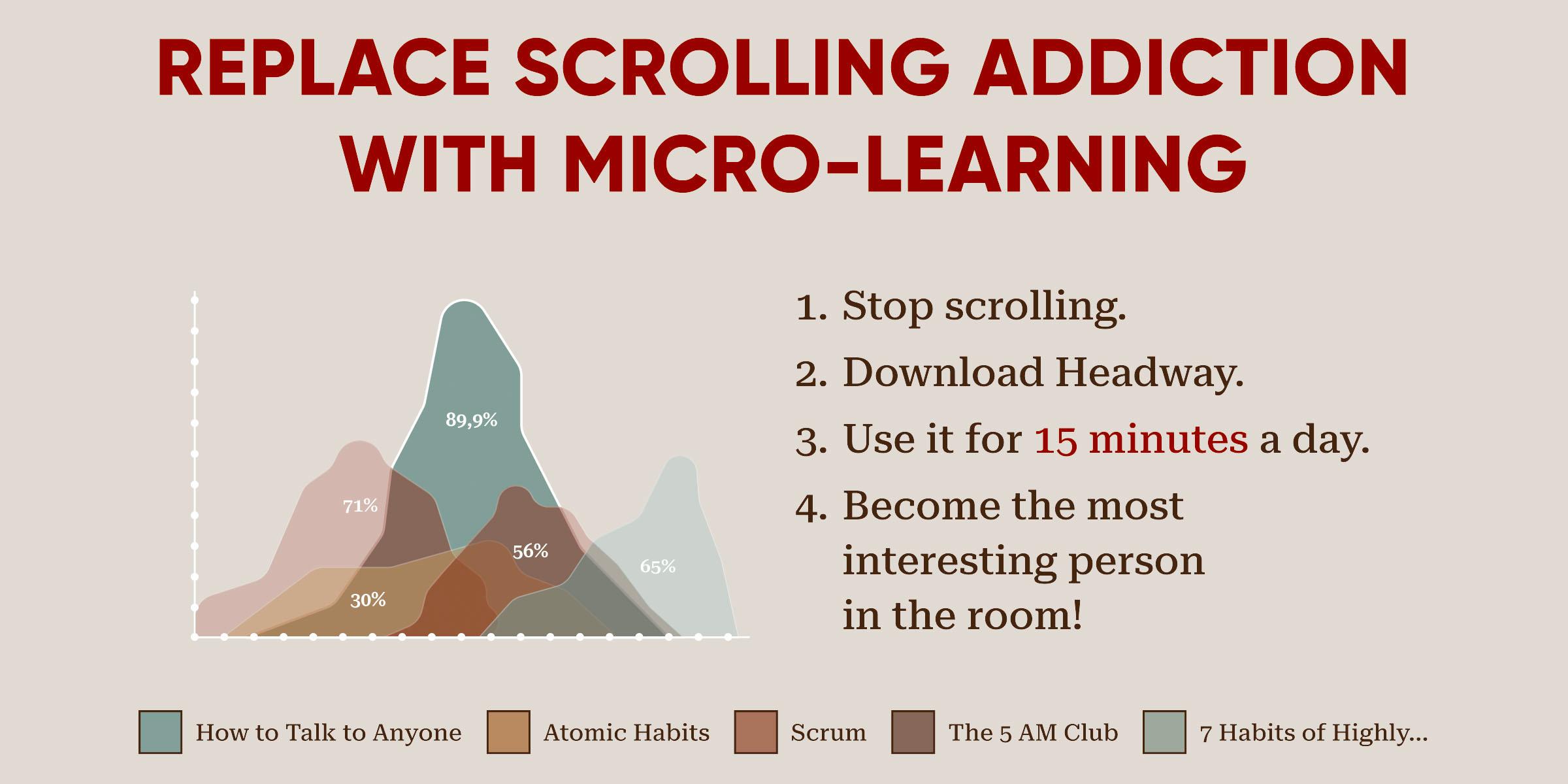
Ever found yourself tumbling down the rabbit hole of endless scrolling? This problem is real since people spend an average of 2 hours and 27 minutes daily scrolling through social media. That's over 5.7 years of your entire life lost to endless feeds — time you could spend growing, learning, and actually living.
If you're tired of losing hours to social media feeds, books like 'Atomic Habits,' 'Indistractable', and 'Digital Minimalism' offer proven strategies to stop scrolling addiction and reclaim your time.
The Headway app brings you these life-changing insights in 15-minute summaries, perfect for turning commute time or coffee breaks into powerful micro-learning sessions that fuel real self-growth.
Download the Headway app and start your self-improvement journey today!
Quick tips on how to stop scrolling addiction:
Set firm boundaries
Replace scrolling with growth activities
Practice mindful tech use
Transform screen time into learning time
Add microlearning apps to your daily routine
Keep reading for the complete guide to breaking your scrolling habit for good!
DAY 1

DAY 2

DAY 3
DAY 4

DAY 5

DAY 6

Five proven strategies to overcome scrolling addiction
Fortunately, by implementing successful strategies and small hacks, we can triumph over our addiction to scrolling and reclaim control of our screen time.
📘 Swap the scroll for Headway — learn something instead of doomscrolling.

1. Set clear, firm boundaries
Addressing an addiction to scrolling begins with setting firm boundaries for ourselves. This process involves:
Establishing daily limits on social media activity by only logging in once daily, thus taking charge of our digital consumption instead of succumbing to the influence of apps on how much screen time we use.
Changing our digital habits, for example, keeping electronic devices outside the sleeping area to cut down on the urge to engage in nighttime tablet and phone use.
Digital detox, or designating specific periods during which phone usage is not allowed, can enhance concentration on activities that don't involve technology, such as enjoying meals or preparing for sleep.
Modifying phone settings and turning the silent mode "off" ensures that the phone serves its primary purpose — to receive essential calls — and minimizes compulsive checking.
Some people also find it beneficial to commit to regular intervals entirely devoid of screens, social media usage, and endless scrolling — such as weekends or specific days — to motivate themselves toward screen-free pastimes.
Listen to more tips in the full summary of James Clear's 'Atomic Habits' on the Headway app.
📘 Download Headway and turn your scrolling habit into a learning habit.
2. Replace scrolling with personal growth activities
Redirecting time wasted on aimless scrolling toward constructive pursuits helps tackle addiction at its core.
Read physical books: Keep a book in your car or bag so reading is as accessible as your phone during vulnerable moments.
Exercise regularly: Physical activity provides a natural dopamine boost, replacing the artificial hit from social media.
Organize your space: Tidying up offers a productive alternative that delivers real-world satisfaction.
Set positive goals: Challenge yourself to read a certain number of books monthly or walk a minimum number of steps daily to establish healthier behaviors.
Use e-readers strategically: Replace digital content consumption with e-readers like Kindle to phase out screen time effectively.
See how these tips help you become happier in the full summary of 'Indistractable' on the Headway app.
📘 Next time you reach for social media, open Headway instead.
3. Use microlearning apps instead of social media
To escape from a relentless scrolling spiral, let Headway be your guide to freedom and microlearning soft skills. Turn moments like commuting or waiting in line into opportunities for growth by engaging with over 2000+ text and audiobook summaries.
The app promotes regular learning patterns by introducing challenges spanning 28 or 15 days — strategies to foster consistent study practices as part of one's daily routine. Plus, see how just 6 months of daily microlearning can transform your life.

Other apps to stop doomscrolling
You can always redirect that same energy into microlearning apps instead of traditional ones that actually improve your life while satisfying your brain's need for engaging content.
Duolingo — Turn your mindless scrolling into meaningful language skills with bite-sized lessons that make learning feel as addictive as social media but way more rewarding.
Strava — Channel your phone-checking habit into tracking workouts and connecting with an active community that celebrates real-world achievements instead of digital likes.
Forest — Plant virtual trees that grow when you stay focused and off distracting apps, turning your phone into a productivity partner rather than a time-wasting trap.
Calm — Transform late-night scrolling sessions into peaceful meditation moments with guided breathing exercises and sleep stories that help you unwind instead of wind up.
Todoist — Convert your compulsive phone checks into productive planning sessions where you can organize your goals and feel accomplished instead of scattered.
📘 Download Headway and turn your scrolling habit into a learning habit.
4. Practice mindful technology use
Rescue Time reports that the amount of time an average user spends on their phone daily is 3 hours and 15 minutes.
Specifically for iPhone users, the average is 80 phone unlocks per day, illustrating a significant reliance on these devices compared to Android users.
To prevent further decline in your attention span, you need to set time limits and be mindful of how you use technology:
Using your devices strategically to enhance productivity instead of allowing them to control us.
Disable notifications to concentrate on important tasks without continuous distractions from our phones or other devices.
Set your screen to grayscale to reduce the tendency for aimless scrolling.
Cultivating psychological resilience and self-discipline is critical to counteracting dependencies and addictive behaviors tied to excessive phone use.
Get more digital insights from the summary of 'Digital Minimalism' on the Headway app.
📘 Next time you reach for social media, open Headway instead.
5. Stay motivated and accountable on your journey
Staying motivated and accountable when overcoming a scrolling addiction and developing healthier online habits is essential. Here are some strategies that can help:
Set clear goals and boundaries for online activity: Define specific times for checking social media and stick to them.
Use website blockers or app limiters to restrict access to distracting apps: Tools like these can help limit access to apps that encourage endless scrolling.
Find alternative activities to replace scrolling: Engage in reading, exercise, or hobbies to fill the time usually spent on your phone.
Join a support group or find an accountability partner: Sharing your goals with others can help you stay on track.
Track progress and celebrate small victories: Keep a journal of your progress and reward yourself for meeting milestones.
By understanding the risks and consequences of scrolling and social media addiction, you can break free from the endless loop of mindless scrolling and improve your overall well-being.
📘 Replace mindless scrolling with Headway for productive screen time that counts.
Why you can't stop scrolling: The psychology behind the addiction
Acknowledging phone addiction is essential to stopping our endless scrolling during our work and free time, addressing our digital well-being, and reclaiming dominion over our existence.
Tech companies have developed apps that can help manage scrolling addiction by blocking distracting websites and apps or prompting users to reflect on their usage before allowing access, thereby promoting discipline and productivity.

1. Blue light disrupts your sleep and health
The visible light spectrum includes blue light, a high-energy component notably emitted by LED screens of TVs and smartphones.
Blue light has the power to hinder the sleep cycle by inhibiting melatonin production — the hormone that controls our sleep-wake rhythm.
Consider how scrolling through your Instagram feed late at night could compromise the quality of your rest.
Blocking apps can help reduce exposure to blue light by limiting access to distracting applications during specific times, enhancing productivity, and improving sleep quality.
Due to its role in disturbing slumber, excessive screen time with no implemented time limits, especially when close to one’s eyesight, can damage retinal cells and increase susceptibility to age-related eye conditions.
Chronic exposure might trigger various other health complications aside from interrupted sleep patterns — truly concerning, considering it only represents a fraction of what comprises addiction related to incessant scrolling habits.
2. Social media apps are designed to hook you
Ever wondered what makes giving up social media so difficult, despite being fully conscious of its negative aspects?
Developers ingeniously crafted social media platforms like TikTok and Instagram to hook us with their allure of constant newness and the ability to tailor content that resonates with our preferences.
These apps tap into our neurological desire for reward by triggering dopamine release — similar to how addictive substances operate — when we interact through posts or get likes and comments from friends or loved ones.
This rush of dopamine creates a satisfying sensation that prompts us to check in with these apps, gradually cultivating a psychological dependence on them.
As this cycle continues, we find ourselves increasingly drawn into the digital realm at the expense of direct human connections, neglecting real-world duties and paving the path toward an addiction to social media.
3. Your brain craves novelty and validation
However, external elements such as the blue light emitted from screens or the addictive nature of app interfaces aren't the only things driving our continuous compulsion to scroll.
Psychological aspects inherent to human nature also contribute markedly. These factors include our quest for newness and satisfaction of our ego.
The rush we get from being a trendsetter or disseminating intriguing information obtained from various sources reinforces this habit.
The urge to frequently check our phones stems not just from technology but also from internal desires — to stay informed, receive affirmation from peers, and momentarily detach ourselves from the burdens of reality.
It also often roots back to FOMO, or the fear of missing out, which drives us to remain “in the loop.” These inner motivators are sculpted within our digital context and play an integral part in shaping our addiction to scrolling.
📘 Try Headway when you catch yourself scrolling — it's actually worth your time.



How scrolling addiction affects your life
Scrolling addiction can have severe consequences on mental and physical health, relationships, and overall well-being. Here are some of the adverse effects of scrolling addiction:

Decreased attention span and increased distractibility: Constantly switching between apps and content can make it harder to focus on tasks.
Increased stress and anxiety levels: The overload of information and constant connectivity can heighten stress and anxiety.
Decreased productivity and efficiency: Time spent on endless scrolling is time taken away from productive activities.
Negative impact on sleep quality and duration: Late-night scrolling can disrupt sleep patterns and reduce sleep quality.
Strained relationships and social isolation: Excessive screen time can lead to neglect of real-life relationships and social interactions.
Decreased self-esteem and confidence: Comparing oneself to others on social media can negatively affect self-perception and confidence.
Understanding these impacts is crucial in recognizing the need to address and overcome the scrolling addiction.
📘Stop losing hours to your phone — get Headway now!
Doom scrolling: When your digital habits turn dark
Doom scrolling is a specific type of mindless scrolling that involves continuously scrolling through negative or disturbing content, such as news articles or social media posts, without taking a break.
This behavior can lead to increased stress, anxiety, and feelings of hopelessness.
Picture yourself glued to your phone, reading one distressing news story after another, unable to stop — this is doom scrolling.
It not only exacerbates stress and anxiety but also contributes to the development of scrolling addiction, with severe consequences on mental health.
Breaking free from this cycle is essential for maintaining a positive and balanced mindset.
📘Make every minute count with Headway summaries!
Break the scroll, start your growth with Headway
The battle against mindless scrolling is real, but you're not fighting it alone. By understanding the psychological and technical factors driving this habit, you can implement proven strategies to stop scrolling addiction.
The Headway app turns those lost scrolling hours into powerful learning moments. Instead of consuming empty content, you'll absorb insights from world-changing microlearning books that contain the exact knowledge you need to build better habits and reclaim your life.
Download the Headway app now and turn big ideas into daily habits. Your journey from endless scrolling to continuous growth starts today!
Frequently asked questions about how to stop scrolling addiction
What is mindless scrolling?
Mindless scrolling is the habitual and often unconscious act of continuous scrolling through social media feeds, news articles, or other online content without a specific purpose or goal. This behavior can lead to a significant waste of time, decreased productivity, and increased stress levels. Imagine finding yourself lost in an endless loop of Instagram stories or Twitter threads, only to realize hours have slipped by — this is the essence of mindless scrolling.
How to replace doom scrolling with microlearning?
To combat the habit of excessive scrolling, begin by establishing boundaries for how much time you spend on social media and carefully choose your feeds. Recognize the potential for addictive behavior and pay attention to input from people close to you.
What factors contribute to scrolling addiction?
Addiction to scrolling can be attributed to exposure to blue light, captivating designs of social media applications that encourage continued use, and a craving for new content and affirmation from peers. Awareness of these elements is crucial when considering our online behaviors and digital routines.
How can setting healthy boundaries help overcome scrolling addiction?
Boundaries work because they interrupt the automatic habit of grabbing your phone. When you keep your phone out of the bedroom or only check social media once a day, you're forcing yourself to pause and make a conscious choice instead of scrolling without thinking.
What are some alternative activities for personal growth that can replace scrolling?
Instead of scrolling, try reading books, exercising, organizing your space, or volunteering in your community. These activities improve your skills, health, and relationships while giving you a real sense of accomplishment that social media can't provide.
How does the Headway app help overcome mindless scrolling addiction?
When you feel the urge to scroll, Headway gives you something better to do. You still get that hit of new information your brain wants, but from book summaries that teach you useful stuff instead of random social media posts you'll forget in five minutes.